Fee Download Use Cases: Requirements in Context (2nd Edition), by Daryl Kulak, Eamonn Guiney
Use Cases: Requirements In Context (2nd Edition), By Daryl Kulak, Eamonn Guiney. Is this your extra time? Just what will you do after that? Having extra or downtime is very remarkable. You could do every little thing without pressure. Well, we expect you to spare you couple of time to read this book Use Cases: Requirements In Context (2nd Edition), By Daryl Kulak, Eamonn Guiney This is a god publication to accompany you in this downtime. You will not be so difficult to understand something from this publication Use Cases: Requirements In Context (2nd Edition), By Daryl Kulak, Eamonn Guiney More, it will help you to obtain far better details and also experience. Even you are having the great tasks, reviewing this publication Use Cases: Requirements In Context (2nd Edition), By Daryl Kulak, Eamonn Guiney will certainly not include your thoughts.
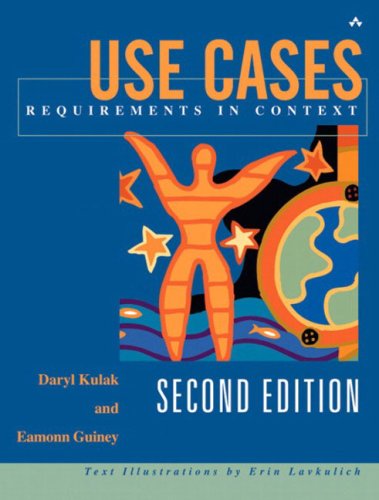
Use Cases: Requirements in Context (2nd Edition), by Daryl Kulak, Eamonn Guiney

Fee Download Use Cases: Requirements in Context (2nd Edition), by Daryl Kulak, Eamonn Guiney
When you are hurried of task due date as well as have no concept to obtain motivation, Use Cases: Requirements In Context (2nd Edition), By Daryl Kulak, Eamonn Guiney publication is among your remedies to take. Schedule Use Cases: Requirements In Context (2nd Edition), By Daryl Kulak, Eamonn Guiney will certainly give you the appropriate source as well as thing to obtain inspirations. It is not only about the works for politic company, administration, economics, and also various other. Some purchased tasks to make some fiction your jobs additionally require inspirations to overcome the work. As exactly what you require, this Use Cases: Requirements In Context (2nd Edition), By Daryl Kulak, Eamonn Guiney will probably be your option.
When visiting take the encounter or thoughts forms others, publication Use Cases: Requirements In Context (2nd Edition), By Daryl Kulak, Eamonn Guiney can be a great source. It holds true. You can read this Use Cases: Requirements In Context (2nd Edition), By Daryl Kulak, Eamonn Guiney as the resource that can be downloaded and install below. The way to download and install is likewise very easy. You could visit the web link web page that we provide and afterwards acquire the book making an offer. Download and install Use Cases: Requirements In Context (2nd Edition), By Daryl Kulak, Eamonn Guiney and also you could deposit in your own device.
Downloading the book Use Cases: Requirements In Context (2nd Edition), By Daryl Kulak, Eamonn Guiney in this website listings can provide you much more benefits. It will reveal you the very best book collections as well as finished compilations. So many books can be found in this internet site. So, this is not only this Use Cases: Requirements In Context (2nd Edition), By Daryl Kulak, Eamonn Guiney However, this publication is described check out since it is an impressive publication to make you more opportunity to obtain experiences and also thoughts. This is easy, read the soft data of guide Use Cases: Requirements In Context (2nd Edition), By Daryl Kulak, Eamonn Guiney and also you get it.
Your perception of this publication Use Cases: Requirements In Context (2nd Edition), By Daryl Kulak, Eamonn Guiney will certainly lead you to acquire just what you exactly require. As one of the impressive books, this book will certainly supply the existence of this leaded Use Cases: Requirements In Context (2nd Edition), By Daryl Kulak, Eamonn Guiney to accumulate. Even it is juts soft file; it can be your collective documents in gizmo and also other gadget. The essential is that use this soft documents book Use Cases: Requirements In Context (2nd Edition), By Daryl Kulak, Eamonn Guiney to read as well as take the perks. It is just what we suggest as book Use Cases: Requirements In Context (2nd Edition), By Daryl Kulak, Eamonn Guiney will boost your thoughts and also mind. Then, reading book will additionally improve your life quality better by taking great action in well balanced.
This book describes how to gather and define software requirements using a process based on use cases. It shows systems analysts and designers how use cases can provide solutions to the most challenging requirements issues, resulting in effective, quality systems that meet the needs of users.
Use Cases, Second Edition: Requirements in Context describes a three-step method for establishing requirements—an iterative process that produces increasingly refined requirements. Drawing on their extensive, real-world experience, the authors offer a wealth of advice on use-case driven lifecycles, planning for change, and keeping on track. In addition, they include numerous detailed examples to illustrate practical applications.
This second edition incorporates the many advancements in use case methodology that have occurred over the past few years. Specifically, this new edition features major changes to the methodology's iterations, and the section on management reflects the faster-paced, more "chaordic" software lifecycles prominent today. In addition, the authors have included a new chapter on use case traceability issues and have revised the appendixes to show more clearly how use cases evolve.
The book opens with a brief introduction to use cases and the Unified Modeling Language (UML). It explains how use cases reduce the incidence of duplicate and inconsistent requirements, and how they facilitate the documentation process and communication among stakeholders.
The book shows you how to:
- Describe the context of relationships and interactions between actors and applications using use case diagrams and scenarios
- Specify functional and nonfunctional requirements
- Create the candidate use case list
- Break out detailed use cases and add detail to use case diagrams
- Add triggers, preconditions, basic course of events, and exceptions to use cases
- Manage the iterative/incremental use case driven project lifecycle
- Trace back to use cases, nonfunctionals, and business rules
- Avoid classic mistakes and pitfalls
The book also highlights numerous currently available tools, including use case name filters, the context matrix, user interface requirements, and the authors' own "hierarchy killer."
- Sales Rank: #800301 in Books
- Published on: 2003-08-04
- Original language: English
- Number of items: 1
- Dimensions: 9.00" h x .70" w x 6.90" l, .98 pounds
- Binding: Paperback
- 272 pages
From the Inside Flap
Use Cases: Requirements in Context came about, as most books probably
do, as the result of a complaint. We felt that there weren't any good books
that addressed use cases for requirements gathering. It seemed that a lot of
people agreed that use cases were a perfectly good tool to solve the requirements
problem, but no one had put down on paper any detailed process to help people
understand how to use them this way. In fact, even as we write today, in late
1999, there is no book of this sort that we know of.
Requirements gathering has been a problem on almost every project we've been
involved with. The fuzzy nature of requirements makes working with them slippery
and unintuitive for most software analysts. Use cases are the first tool we've
seen that addresses the specification and communication concerns usually associated
with requirements gathering.
Although use cases in themselves are quite intuitive, the process around them
is often done poorly. The questions that people have--How many iterations do
I do? How fine-grained should a use case be?--are not answered or even addressed
in most texts. This is probably because they are hard questions and the answers
can vary greatly from one situation to another. However, they are important
questions, and we decided to describe our own best practices as a first volley
in what we hope will become a spirited industry dialog on how to generate requirements
that will address user needs.
Use Cases: Requirements in Context is a practical book for the everyday
practitioner. As consultants in the information technology industry, we employ
use cases to specify business systems as part of our daily lives. We think we
understand the issues facing people when they deliver software using tools such
as the Unified Modeling Language and use cases. Our main intent is not to describe
use case notation, although we do address that. Instead, we show a requirements
process that addresses requirements gathering in a way that produces quality
results.
While writing, we considered the factors that cause problems in requirements
gathering, and we developed a use case method for delivering a requirements-oriented
set of deliverables. The methodology breaks down the activity of producing requirements
into a series of steps, and it answers the questions that usually come up when
people employ use cases. This book relates directly to the real work of delivering
a specification, managing that effort with a team, and getting the most bang
for your buck.
The sample use cases and use case diagrams that appear throughout the book
are also presented in Appendixes B and C. These appendixes demonstrate the development
of the use cases and other requirements analysis artifacts through each phase
of their development. Appendix B documents a business system for real estate,
and Appendix C documents a business system for the garment industry.
We hope you enjoy this book. It was a labor of love for us. This is a process
that works well for us. If it works for you, too, that's great. If it doesn't,
perhaps you can adapt some of the tools, ideas, or suggestions to your own way
of addressing the requirements problem.
0201657678P04062001
From the Back Cover
This book describes how to gather and define software requirements using a process based on use cases. It shows systems analysts and designers how use cases can provide solutions to the most challenging requirements issues, resulting in effective, quality systems that meet the needs of users.
Use Cases, Second Edition: Requirements in Context describes a three-step method for establishing requirements--an iterative process that produces increasingly refined requirements. Drawing on their extensive, real- world experience, the authors offer a wealth of advice on use-case driven lifecycles, planning for change, and keeping on track. In addition, they include numerous detailed examples to illustrate practical applications.
This second edition incorporates the many advancements in use case methodology that have occurred over the past few years. Specifically, this new edition features major changes to the methodology's iterations, and the section on management reflects the faster-paced, more "chaordic" software lifecycles prominent today. In addition, the authors have included a new chapter on use case traceability issues and have revised the appendixes to show more clearly how use cases evolve.
The book opens with a brief introduction to use cases and the Unified Modeling Language (UML). It explains how use cases reduce the incidence of duplicate and inconsistent requirements, and how they facilitate the documentation process and communication among stakeholders.
The book shows you how to:
- Describe the context of relationships and interactions between actors and applications using use case diagrams and scenarios
- Specify functional and nonfunctional requirements
- Create the candidate use case list
- Break out detailed use cases and add detail to use case diagrams
- Add triggers, preconditions, basic course of events, and exceptions to use cases
- Manage the iterative/incremental use case driven project lifecycle
- Trace back to use cases, nonfunctionals, and business rules
- Avoid classic mistakes and pitfalls
The book also highlights numerous currently available tools, including use case name filters, the context matrix, user interface requirements, and the authors' own "hierarchy killer."
0321154983B07012003
About the Author
Daryl Kulak is the president and CEO of Water-Logic Software (www.water-logic.com), an Internet business and technology consulting firm based in Columbus, Ohio. He is a graduate of the Northern Alberta Institute of Technology (NAIT) in Edmonton, Alberta. During much of his seventeen-year career managing software development projects in the United States and Canada, Daryl has focused on use cases, iterative/incremental development, and component design. Eamonn Guiney is a consultant at NewtonPartners (www.newtonpartners.com), a company that provides management consulting and system integration services to the money management industry. He is based in Sacramento, California. Eamonn creates business systems using a variety of tools, particularly object-oriented methodologies and use cases.
0321154983AB04012003
Most helpful customer reviews
41 of 41 people found the following review helpful.
Useful Use Cases
By R. Williams
The best thing about this book is that the authors are not meekly presenting just a stream of bland bromides that echo the sentiments of a million other talking heads. On the contrary, they are quite opinionated and their opinions often illuminate some of the most important issues in the whole raging process debate. Specifically, their discussion of the uselessness of requirements that just appear as a gigantic list of commandments is truly on target. (The writers espouse attaching requirements to the appropriate [and specific] use case.) They also do a good job of dealing with the issue of scope and developing use cases for specific uses. Everyone who's read about use cases has confronted the issue of how to 'refine' them but this book does a better job than most at underlining the importance of scope in the iterative process.
The downsides of this book (IMHO) are:
1. The diagrams are all very simplistic. There really is no point in using a pictographic medium if there's nothing there.
2. The models that are talked about are also too simplistic (but I say that about every book).
3. There is a little bit of smugness about how *their* way is the sane and obvious answer to all that ails developers.
Still, I think this is one of the best Use Case books out there.
26 of 27 people found the following review helpful.
The Best Use Case Book I've Read So Far
By Laus Deo
Programmers naturally hate use cases. They seem boring, and having seen hundreds of them (written by others and handed to me) over the years, I had lost hope that this practice would ever be of any benefit. I had grown tired of constantly reading varying levels of abstraction and `use-case-itis'. All this, despite the fact that Jacobson's original work and the UDP incorporation of use cases as central to that process was clearly a better way to go than wading through hundreds, sometimes thousands of pages of `shall' statements that accompany most projects (and too often, lead to their failure).
Then I read this book. I now use it regularly in every requirements-related class I teach, and I tell every programmer I meet to buy this book. Imagine a use case book that programmers can actually get excited about! This book blazes new territory and its practical insights and humor make it a fun read, as well.
Here are the great highlights:
1. Properly scoping and relating use cases
2. Introducing Business Rules as 'first-class citizens"
3. Applying UDP iterations to the use case development process.
These last two items make the book stand out. Understanding the importance of business rules as enterprise-wide invariants that span use cases is ground-breaking. The four UDP iterations are ingenious because they can help to enforce the proper level of abstraction, which is a big problem area for use cases. Try it, you'll like it!
In addition, the book is loaded with great practical advice and examples of good (and bad!) use case text. And finally, the authors present the most compelling arguments I've ever heard for ditching traditional requirements-gathering methods (which have clearly FAILED), because use cases are, after all, requirements IN CONTEXT (like the title says). If every use case writer read this book and followed it's advice, the software crisis would be dealt a serious blow.
Bottom line : If you write use cases (or worse, are forced to implement bad use cases at gunpoint), get this book!
12 of 12 people found the following review helpful.
Great book but where's the templates?
By Todd Clarke
This book is very concise and super helpful with it's concrete examples. This is the best book on documenting requirements that I have seen and I have been lokking for quite some time. Sure wish though there was a CD that had Word templates! Seems silly for me to have to create all these from scratch when they are right there in the book. Darn.
Use Cases: Requirements in Context (2nd Edition), by Daryl Kulak, Eamonn Guiney PDF
Use Cases: Requirements in Context (2nd Edition), by Daryl Kulak, Eamonn Guiney EPub
Use Cases: Requirements in Context (2nd Edition), by Daryl Kulak, Eamonn Guiney Doc
Use Cases: Requirements in Context (2nd Edition), by Daryl Kulak, Eamonn Guiney iBooks
Use Cases: Requirements in Context (2nd Edition), by Daryl Kulak, Eamonn Guiney rtf
Use Cases: Requirements in Context (2nd Edition), by Daryl Kulak, Eamonn Guiney Mobipocket
Use Cases: Requirements in Context (2nd Edition), by Daryl Kulak, Eamonn Guiney Kindle

Tidak ada komentar:
Posting Komentar